Your Dog Training Question Answered: “My Dog Jumps On Everyone!”
Boston Dog Trainer Jackie O’Neil Talks About a Common Dog Behavior Issue
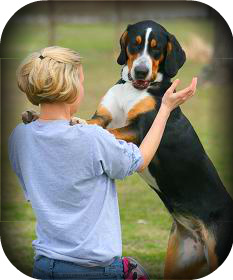
I’m a Boston Dog Trainer, and every day my inbox includes questions about how to stop a dog from jumping. This question is usually followed by a list of things the person has tried thus far. It seems to me that there are even more ridiculous “solutions” out there than there are people looking for answers! So let’s dissect this issue to find out why dogs jump, why these common crazy “solutions” don’t really work, and what we can really do about it.
Why do dogs jump on people?
Most peole would say that their dog jumps because he’s too excited. He is likely too excited, but that’s not why he jumps. Dogs jump during greetings for many reasons. First, the obvious and most common reason: the dog wants your attention. If there are other dogs present, they may all be competing for your attention. If your dog is a particularly forceful and relentless jumper, he may be demanding your attention. I recently worked with a dog like this. He would demand attention via jumping, then would growl and snap about 30 seconds after you gave it to him. Why? For this dog, demanding that you pay attention, and then demanding that you leave him alone, was just a normal part of life. He was used to controlling his environment, and used to saying what he wants and doesn’t want. There were never any consequences for this behavior (either the jumping, or the growling, or the snapping) except to be sent to his crate for a time out. Let me say that there is one dog training technique that I know, for sure, does not work: time out. Your dog is bright, but he cannot reason. He doesn’t know why he’s separated and confined. Without being able to tie the action (growling/snapping) to the consequence (the separation and confinement), it’s meaningless. If you’re currently using your crate as punishment, I’d recommend you stop immediately. There are many reasons why, but that’s for another article.

When a dog jumps on you, she may also be “claiming” you. This looks so similar to the dog who is demanding attention that it may be impossible to tell them apart. One hint that the dog may be claiming you is if she jumps, rests her paws on you, and looks around at everyone else as if to say “are you all seeing this?” This is usually just as harmless as the dog who jumps for attention, but not always. Sometimes, the action of a dog “claiming” a certain person can be a prelude to a conflict either between the dog and other people, or the dog and other dogs. You will likely not be able to distinguish whether your dog is “claiming you” or if he is just trying to get attention. Don’t worry though – it doesn’t really matter (more on that in a minute).
There is also the possibility that the dogs intention is simply to lick your mouth. In dog behavior, this is often a submissive gesture. Even if this is your dog’s intention, he/she is still taking control of the situation, which is unacceptable. Plus, many people don’t appreciate “kisses” from a dog! ***I know there is a Lindsay reference for this but my books aren’t with me***
Regardless of why a dog starts jumping, it can and will quickly become something meaningless if left unchecked. Dogs are stimuli response animals, meaning they don’t think things through. When A happens, I do B. When people come in, I jump. If they’ve had enough time to practice jumping, it just becomes something they do. (Sort of sidenote: this is why it’s not harmless to let a puppy jump. Unless you get lucky, your dog is not likely to grow out of this behavior!) When people come in, I jump on them. There is no “why.”
Overall, it’s not really important to understand why a dog jumps – attention, claiming, submissive gesture, learned behavior, etc. Its only important to understand and accept that it’s inappropriate, and needs to be addressed. Whether a dog is 100 lbs or 10 lbs, it’s inappropriate. A large jumping dog can create a lot of physical damage (think about Grandma falling and breaking a hip, or a toddler cracking his head on a nearby piece of furniture, or a table crashing to the ground and shattering a lamp into a thousand pieces), but a small jumping dog can be a hazard as well. A small dog might not have as much potential to directly cause damage, but it can alarm someone, frighten a kid and cause him to back into something, scratch someone with its tiny dagger nails, etc.
Regardless of a dog’s size, jumping is inappropriate because it is representative of the wrong state of mind. A jumping dog is making his own decisions; a jumping dog is taking control. What does that say about your relationship with the dog? A dog should be under your control, and should be responding to your instruction. Not because he’s a lowly, inferior creature, but because he’s an animal. If we want him to peacefully and safely coexist with us in our homes, we need to train him to respond to us, not the other way around! It also says quite a lot about his lifestyle in his home. The freedom to take control of such a situation (guests entering your home) is quite a bit of freedom!
Why don’t quick fixes work for a jumping dog?
First and foremost, in order for any approach to create lasting change, it should address all the variables that influence the dog’s behavior. This includes, but is not limited to, the aforementioned relationship between dog and owner, and the dog’s lifestyle. That said, there is one way to get rid of bad behaviors: consequences. Before you say you don’t believe in telling a dog no, think about this: consequences are a normal part of life. What would happen if there were no consequences for bad human behavior? Chaos. Consequences are a normal part of life for the entire animal kingdom; dogs are no exception.
In order for a bad behavior to stop, there has to be sufficient motivation to stop doing it. You can try to redirect your dog with treats, or teach him a different response using treats (reward) alone, but in order for that to work, the desire to eat a tasty treat has to outweigh your dog’s desire to jump. This is why a treat-based trainer shows up armed with hot dogs, not Milkbones. However, most dogs enjoy jumping so much that even a hot dog isn’t enough to change that behavior pattern. Sometimes short term progress can be made, but I’ve never seen this approach achieve lasting results.
So if treats are neither an effective, nor efficient way to stop a dog from jumping, what kind of consequence should you introduce? How do you know if it’s a sufficient motivator? In order for something to be considered a “consequence” it has to hold weight, which means it will vary based on the dog’s personality, temperament, size, desire to do the undesired behavior (in this case, jumping), etc. If it doesn’t stop the bad behavior from happening, it isn’t enough of a motivator. This is why “time outs” in the crate aren’t a consequence – the dog isn’t able to associate it with a specific action so it’s unable to hold any weight. There are many common suggestions for consequences for jumping: the squirt bottle, the shaker can, and a knee to the chest, to name a few. I’ve met people who swear by the squirt bottle, but let me as you this: how many times have you refilled that thing? Countless times, right? And you’ve gotta have a full tank if you know people are coming over, right? So the squirt bottle might stop the dog from jumping once he’s started, but it doesn’t prevent him from jumping in the first place. Even if you’re okay with that – “oh, that’s fine. I don’t mind carrying it around. I don’t even have to squirt it anymore, just hold it up!” – is it really fair to be continually punishing, or threatening to punish the dog? I don’t think so.
So how can you teach your dog not to jump in the first place? This is where my approach is unique.
I believe in setting a dog up for success as much as possible. We, as humans, can reason. We can think things through, and arrange the variables in our environment so that the dog is set up to make the right behavior choice to the greatest extent possible. I believe it’s only fair to do so.
So when your dog is in a situation where he’s likely to jump, say, when company comes over, take away his opportunity to jump by giving him something else to do! Try the place command, or a sit/stay, or a down/stay. If he still makes the wrong choice, only at this point do consequences come into play. Remember, your consistency is the number one factor determining whether or not your dog will get it!
I have purposely avoided making specific recommendations regarding tools and methods because this advice largely depends on many variables (the individual dog, situation, etc.). Nevertheless, I hope this article has shed some light on the jumping issue! If you are searching for a Boston dog trainer to help you with your dog’s jumping issue, or any other behavioral problem, please call me at 800.649.7297 or use my contact form. I would be happy to talk with you about your dog’s issues, and exactly how I can help!